Tuesday, May 23, 2006

His Bobness!


Tomorrow Bob Dylan will attain an age of 65 years. O yes! Milestone and all that, for a man who is something of a milestone himself. I first heard him when I was probably ten years old. What I mean is consciously heard him. My young blood in those days wanted The Stones and The Beatles, The Swinging Blue Jeans (“Hippy, Hippy, Shake!” – anyone remember that one?), little knowing what the slightly boring voiced singer of the wind blown anthem meant to those guys! And then one day in my life, Bob Dylan hit me a musical blow I’ve never really recovered from.

That’s almost the same thing that happened to Lou Majaw of Shillong. For the last ten years or more he has been instrumental in planning and organising a BD birthday tribute in the Meghalaya capital. It has also extended itself to a performance by Lou and the Ace of Spades in Calcutta’s Someplace Else. Not exactly an ideal venue (is there any?) but it does till a better one comes up.

Let me also tell you that other than Lou, musicians I respect as much as I do Dylan make up the Ace of Spades. There is of course Nondon on drums, Hiltu-da – Lew Hilt on bass. And the inimitable AJ – Arjun Sen on lead guitar. I also have a slight edge. I know them all at a very personal level and spend a lot of time with them when this show, and similar shows happen. With AJ and Lew living in Delhi, these are great times to get together. So we hung out before the show, rapping and exchanging notes, listening to music, partaking of The Park’s generosity, and waiting for 10 pm when it would be time to go down to SPE.

Nondon arrived punctually as he always does, and some laughs and repartee later, guitars on shoulders, remembering to take their room entry swipe card, we lifted downstairs. SPE was crowded, but it’s such a small space that 10 people can make it look like a full house. Majaw changed the opening song onstage five minutes after they’d decided what it would be upstairs, but that was all right. They’re experienced musicians who can handle any given situation, and I really mean any.

But I will not tell you which songs they sang. If you’re a Dylan freak or fan, they will all be familiar, and if you’re not, then maybe you should have been there. What I will tell you is that they were mostly like what Dylan himself is, a constant reinvention of the known, often drifting off into unexplored places and then finding their way back home. The purists were not happy, but then BD was never a purist either.

Later, post-performance, the band was not happy with the evening. They felt a big hole had been left behind. They are some of the most intensely self-critical guys I’ve seen. It’s what makes them great musicians too. I felt that the energy which comes back from an audience was lacking too. SPE’s greatest failing is this. It is too much of a scene where alcohol intake supersedes the music one comes to listen to. It’s an altogether head banging, feet tapping session rather than a serious listening effort so the band can’t feed off audience response and give back in kind.

Nevertheless a good time was generally had by all (I love this cliché!). Reasons? For some, much money was spent on booze, so they were compelled to. For others, listening to great musicians, who themselves have grown up listening to His Bobness, is in itself a treat to be savoured. And for many of the younger generation, who have not had the opportunity to be intensely exposed to BD and others of his ilk my generation heard, they got their chance at extremely good second-hand lessons.

His Bobness has inspired personal and creative reinvention as much as he did to himself and his art. That’s why the world will always pay tribute to Bob Dylan.

Sunday, May 14, 2006

Gour Khyapa!


We hoped that the full moon of Buddha would charge the atmospherics and enrich our evening. We hoped that the heavy “pre-monsoon” showers which inundated the day would not continue in the evening.

Man proposes, god disposes is a convenient adage to use even for the die-hard non-believer.

Buddha Purnima gave us a fleeting glimpse of her rare beauty before she was smudged from our sight by the rain clouds. As soon as that happened, it began to rain, the one thing we desperately hoped would not.

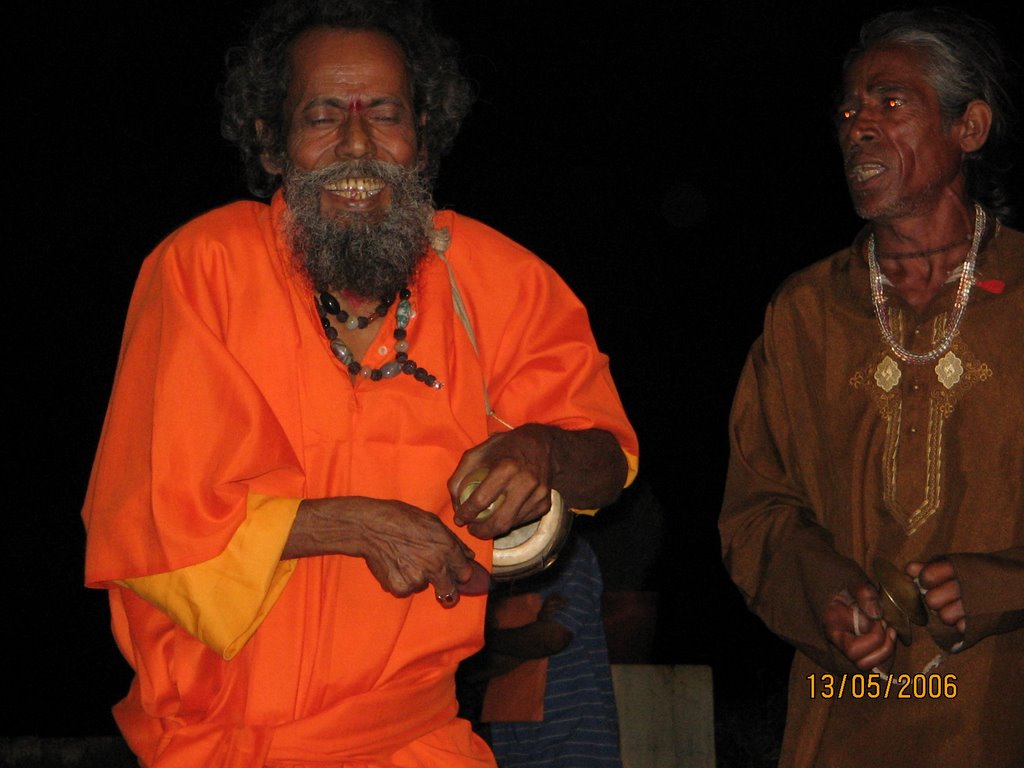
But Gour Khyapa had spoken to the skies, and it did stop after a brief downpour. The rains may have wet the floor, but it did nothing to dampen the spirits of music lovers congregated on the rooftop of one of south Calcutta’s best known landmarks. There were barely twenty people when it was time to start, and there were a hundred when Gour was in full voice.

An enchanted evening was had by all is putting it mildly, even diplomatically. Gour perhaps, is not in full form these days due to his ill-health. Yet he sang, he danced, he made witticisms, and passed often politically incorrect comments; and those who have seen him perform when he was at his peak were reminded of those days of yore. Whatever it was, Gour can still entrance like few performers can.

When I’m at great music shows, I cannot but recall Stevie Wonder’s lyrics from his song ‘Sir Duke’: “Music is a world within itself / It’s a language we all understand”. Gour sang in Bangla, but what did that matter to a large part of last evening’s audience who didn’t know the Bengali language, yet sat there mesmerised? They were captivated by the language of music and that was enough.

Requests poured in from listeners who had heard him perform twenty years ago and would never forget his songs. There were others who sat at his feet and sang every word along with him. A friend, a very able blues harp player who had never heard Gour before, was moved enough to take his harmonica out at one point and jam with the mad Baul. I swear there was a crackle in the air and it had nothing to do with the lightning that scarred the overcast skies!

For those who may not know (and I include my own ignorance), Baul geet is significantly influenced by Hindusthani classical raags and raaginis. However, because of their free ranging spirit and their open minds, Bauls merge one or more raags to create a tune and feel of their own, and add a distinctive flavour that is not possible if one sticks to the classical tradition. Gour is one of those very few learned Bauls who knows the raags or raaginis his songs are based on, and later, after the show, he discussed this aspect at some length with a classically trained musician who had been one of his enchanted audience.

I find it necessary to describe the setting for the show. It perfectly suited the ideas we have about what we would like to do in our interactive project with folk and ethnic musicians.

The stage was the open rooftop of a popular market building flanked by a constantly buzzing flyover that spans the crossroads of the busiest locality of south Calcutta - Gariahat. Our neighbour was the police thana. In addition to us, the silent spectators of the show were a multitude of beautifully nurtured potted plants, the angular steel structures of giant billboards, a cellular phone tower, the slatted façade of a huge AC cooling tower, and the squat ugly boxes of smaller air conditioners. Random sacks of cement and stacks of new bricks were unintentional art installations which enhanced the sculpted setting. It was as urban an ambience as you could get.

The audience was urbane, most comfortable when speaking English. The performer was a man from rural Bengal, who in the first few moments gauged his listeners, peeped into our souls with his vast experience, his understanding from the philosophy he lives, and then sang for us because we wanted to listen.

When Gour Khyapa sings even the gods pause to listen.

****

Once it stopped raining at 8 we had no rain till midnight, and then we had to regretfully pack up amongst protests, requests, and promises for future shows.
___________________________

The first two photos are by Santayan. My sincere thanks to him.

Tuesday, May 09, 2006

Bauls

The pronunciation does not rhyme with Gauls, and so should not lead to adolescent humour as it did when I told someone about this community of wandering minstrels from Bengal, and he had difficulty pronouncing it. It is Ba-ools, more or less.

The Bauls are more than wandering minstrels. They are philosophers, mystics, observers and commentators, rebels; and by their own admission, mad. However, this lunacy is not the kind that warrants psychiatric or psychological attention. It is the madness of the man seeking his “inner being” through his love of god. Again, this god is of no particular denomination, and Bauls can be from Hindu, Muslim, Buddhist religious communities and any beliefs in between. Defining their belief system is itself a major task.

The Bauls’ music is simple and evocative. But it also has hidden meaning in straightforward, sometimes off-the-cuff, lyrics. They pluck out examples from normal, human daily living to sing of the oneness that must be achieved in mind, body and spirit so that we can all live a life of divine sustenance. The Bauls tradition is oral and so the language of their songs change with the times they are in, making them of great and instant appeal to the common man and intellectual alike.

There’s plenty more about Bauls, but I will end this post with just one more fact.

Today, May 9, is Rabindra Jayanti, Rabindranath Tagore’s birth anniversary. Tagore, as a poet-musician-philosopher, derived immense inspiration from Baul music and it greatly influenced many of his compositions and thinking. In fact, people with musical sensibilities and interests should not forget that Tagore was probably one of the first “world” musicians. While his learning was in the Indian classical tradition, he broke away from its rigidity and incorporated Baul, Bhatiyali, Murshidi and other Bengali folk and ethnic music influences, as well as used his understanding of Western classical and other music from Britain to add those distinctive flavours in his music, which thankfully, was not the mass-produced “fusion” of today.

In Bangla, the term “baul mon” (literally, the baul’s mind) depicts the state of mind when everything that is material and of this world is left behind to seek that certain spiritual realm, forever out of our grasp.

Monday, May 08, 2006

Look out for my future post on The Bauls of Bengal


For all those rock music fans: Garth Hudson of The Band recorded Purna Das Baul in the late 60s and an album was released called Bauls at The Big Pink. Anyone got it?


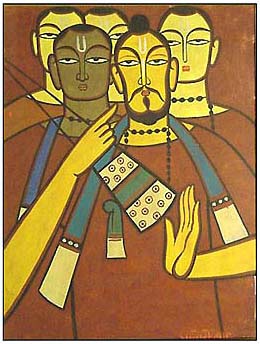
Painting by Jamini Roy

Look out for my future posts on the Bauls and use the link
Bull's Run on this page if you'd like to see a private performance of the Baul, Gour Khyapa on Buddha Purnima, 13th May 2006.

Saturday, May 06, 2006

Age

I have commenced living the 49th year of my life.

What is that supposed to signify? Forty plus years of ignorance and bliss? More than forty years of swimming around in a shallow pond? Over forty years of never knowing the difference? Forty nine years of experience gained and lessons learned?

Age has the notion of becoming a millstone around one’s neck. Certain behaviour, certain wisdom, certain expectations make demands on one merely because one has reached a chronological point in time in one’s otherwise insignificant life. Suddenly, what you are most expected to share are memories.

As you age it becomes a barrier to re-employment. Age significantly reduces one’s physical capabilities. Age diminishes possibilities of getting financial aid and income opportunities. Age debars one from insurance, and reassurance. Age gets you back-handed compliments. It earns you wary respect, often condescending.

So who needs to age? As The Man said, who said almost everything that my generation had to say, wanted to say, never thought of saying, I want to be "Forever Young"! Or, just be ageless...?

Friday, May 05, 2006

Eyes

Eyes are fascinating features of we humans. I see more of a person through their eyes than from their conversation.

Young eyes see better
They know who I am
They watch very carefully
And don’t give a damn.

Older eyes know better
Though myopic in sight,
Years of watching everything
Have let them see the light.

Ancient eyes in cataract
Don’t want to see anymore,
And in their mind’s eye
They’d rather, remember days of yore.

My eyes watch in silence
In my head the voices speak,
I watch the watcher watching
And drown in the depths of sleep.

Saturday, April 29, 2006

Magic

Another of my attempts at verse!

Deep in the heartland,
In the forest that entraps the night
Under its leafy shade,
In the hollows beneath rocks,
In streams where the water sounds,
And my fingers in it can feel the wet,
I look for magic.

On a stage stuffed with gimmickry,
Lit bright, as nimble fingers prestidigitate,
Simulate wizardry,
In the wide open eyes
Of child and adult in me,
As my breathing pauses –
I look for magic.

In the silent sanctuary of a church,
Behind the oil lamps in a temple,
In the moonwashed smoky night of a flaming pyre,
Beneath the high eaves of ancient caves carved in love,
I seek the truth,
I burst my skin,
I look for magic.

In the house, on the street,
And on the grinding tram beneath my feet,
In the hushed halls of education,
In the warp and weft of celebration,
I look for magic
In the wrong places.
The magic is in me.

Wednesday, April 26, 2006

Ummm...?

"You cannot escape one infinite...by fleeing to another; you cannot escape the revelation of the identical by taking refuge in the illusion of the multiple"
Umberto Eco, Foucalt's Pendulum

A Matter of Sex

What is this obsession with sex we humans have? My question is not why we have sex, the answer to which is as obvious as the differences in gender. It concerns why we are obsessed with everything that may be directly, indirectly and remotely connected with the act of sex.

Animals (and the word encompasses all living creatures except humans and plant life) have elaborate mating rituals, often strange behaviour leading to sexual congress and the ultimate and natural need to procreate. It is normally seasonal and limited to an annual event.

We humans not only have sex all year round, anytime, anywhere, anyhow; we are also particular about discussing it in depth, displaying it, debating it, being deviant with it, desiring and denigrating it, never getting enough of it physically, mentally or spiritually; and are either apathetic or empathetic to this original requirement to reproduce our kind.

Yes, we are humans with brains that allow us to think, analyse and process information, and respond to external stimuli. And we can’t help doing so. In all honesty, this piece of writing itself is a by-product of our obsession with sex and all it means to us.

Yet, why? Why is sex is so important to us even if it has moved beyond the ultimate goal of procreation? I don’t believe there are any easy answers.

The phenomenon is not new either. Very early on in our civilisation as we know it, texts on the act of sex began to appear. Nudity portrayed in art became popular. In modern times, once photography was invented, pictorial renditions of sexual acts were commonplace. Today the bulk of the Internet’s economy is driven at a furious pace by websites offering sex.

Again, why? Because there are millions who will have their most satisfactory sex by hearing and watching images and reading text on the WWW, never really experiencing the other sensations of touch, taste and smell with anyone but themselves, and if they’re lucky a partner.

Because there are other millions who will use the portrayal of sex on the Web for titillation, and then look for opportunities to experience sex themselves. Another possible answer.

A third. Because the human imagination is a greater force than what the human mind instantly perceives from received information. The Internet’s portrayal of sex, even though many sites claim to leave nothing to the imagination, is still limited to what it can audio-visually offer the viewer. It cannot account for psychological, demographical, geographical, medical, educational, legal and social factors that will affect those who seek sex on the Internet.

It often seems that the demand for information and imagery of sex, and the accompanying facility to discuss sex issues at a common, amateur level, far outstrips the availability and supply of such services. Sex is an industry that only registers continuing growth, remaining unaffected by political, economic and social conditions. No laws or social strictures are adequate or comprehensive enough to cover the exploitation by the sex industry. Is it because millions wish to be exploited?

Valid as well as populist research on sex and its diversities receives generous funding and often ecstatic approbation. News with a sex angle to it receives intense media attention. Censorship of works of art for reasons related to sex is more common than for political reasons. In fact, politics can be deeply impacted when a sex angle comes into the frame.

Music, graphics and imagery, text, clothing and lifestyle accessories, all sell well when sex is introduced into it in one way or another. Marketing gurus infuse flavours of sex into their strategies to ensure better returns. Our obsession with sizes and shapes is undeniable. Who’s taller? Who’s bigger? Who’s longer? Who’s thicker? Who’s better? Who’s prettier? Who’s shapelier? Who’s perfect? All these seemingly innocuous questions link up in some way with sex.

Child sex, geriatric sex, same sex, animal sex, sex, sex, sex. The mystery of sex. The canons of sex. The fascination of sex. The language of sex. The secrets of sex.

As I said earlier, no easy answers and far too many questions.

And the fact of the matter is, these questions will not even cast a blip on the radar of human sexual activity.

The Woodstock Generation

I’m reading a book called No Logo written by Naomi Klein and first published in 2000. It’s been written lucidly, with great clarity and is a seminal work. She has been called “a young funky heiress to (Noam) Chomsky” and this book of hers has been termed “visionary”, “a riveting, conscientious piece of journalism and a strident call to arms”, “a bible for anti-corporate militancy” and “a powerful and passionate book”. Fortunately enough, for once the back-cover blurbs have got it right.

While I will not tell you what the book is all about, the title and those quoted blurbs should give you a fair indication. I recommend you go across to your favourite bookseller and get yourself a copy. You will not regret it even if you consider yourself an extreme corporate guerrilla. What I will do is quote a sentence from the book, one of so many sentences which made a forceful impression on me.

“What struck me most was that the debate revolved entirely around the sanctity of the past, with no recognition of present-tense cultural challenges.” - Naomi Klein’s comment on the controversy surrounding Woodstock ’94, the 25th anniversary festival of the original Woodstock of 1969.

I was 12 years old when Woodstock happened a couple of continents and oceans away from India. I got to see the movie (in a censored version) about five years later. (Today I own a DVD copy of the full version known as “The Director’s Cut”). But I also know that the ‘69 Woodstock affected me quite a bit and influenced subsequent changes in my life. I recognise some of the changes and others of my peer group have their own, making it a sort of ‘psycho-communal’ sharing of a second-hand experience.

India was undergoing changes and adjustments of her own, and being the urban, educated elite that we were because of our advantageous circumstances, we could not not be affected by what was taking place in the USA. For many of us Woodstock made an immediate impact and we alienated ourselves from our own culture. For some, we learned lessons for the future which have proved right and wrong and this may have given us direction. Still others, reacted negatively to it and called it a hippie plot to dominate the world. A contradiction in terms if there ever was one!

Whatever Woodstock may have meant then, it has been for many of us a catalyst in our lives. The hippieness of that Love and Peace thing made me even more conscious and aware of my own country, its myriad peoples and culture, and the fact that the hippies were coming to my country to be enlightened, while I saw mine in their country! My becoming aware of just that one fact has influenced my life to a great extent. It has prompted me to chose my current lifestyle, my political and ideological leanings, and the sort of work that most satisfies me, an antithesis of all that young people are presently being taught at business schools in India.

But we cannot forget those who continue and choose to live in “the sanctity of the past” believing it to be the be-all and end-all of a life worth living. The repetition of history only occurs for such persons who imagine an ideal time that has passed and can never be rediscovered. They remain afraid of the present and the future because of the unknowns that hover in it and do all they can to propagate a way of thought that holds no benefit for future generations. They have not learned from the past. They only want to relive their version of it.

And that probably is also what Naomi Klein is attempting to reflect upon in her book. The branding of our lives and the “logo-isation” of it is what is being questioned. The global village has shrunk to become a single market where the cross-fertilisation of cultures has no place and everything we say, do and think is influenced directly and indirectly by aggressively marketed brands. In so doing the brands have become us and as consumers we no longer influence the brands.

I strongly recommend the following two books as additional reading for an insight into the changes since Woodstock 1969 was a happening that influenced other peoples who have Western culture thrust upon them and absorb it willingly.

§ Media Control: The Spectacular Achievements of Propaganda, Noam Chomsky, 1991-2002. First Indian edition from Etch, an imprint of Natraj Publishers, Dehra Dun.
§ Mediated: How the Media Shape Your World, Thomas De Zengotita, 2005. Bloomsbury Publishing, London.

THINGS


This was written on the first day of this year. Yep, that's how long its been since I've posted something! So enjoy... and I hope you will do some serious thinking too.
_______ ??? _______


On New Year’s Day a TV channel is showing a re-run of that fat, ugly American’s documentary film that pays sneaky homage to outrageousness. A date in history, in its reversed US form, whose numerals share similarities with temperature measured in Fahrenheit is offered to us as a burning topic for a new year that is yet to recover from a tsunami and American colonialism in Iraq. I’m sure we can look forward to the fat man’s take on that as well.

Things are everywhere. They tempt as objects of desire; as must-haves; as odes to disposable incomes; as the fruits of a surging economy. Things are wanton in the flaunting of their beauty, their cutting-edge technology, their colours, styles and patterns. Things project the exuberance of youth; add fuel to an already overwhelming desire among the older-aged to revert to a younger time that seemed to have slipped by unnoticed, unexplored.

Things have human form too. Things that grab single, lonely people to dream of future companionship and perhaps just physical comfort currently deprived of. Beautiful young things dressed to please with their sculpted bodies, armoured in a sheen of glamour, in their minor celebrity status, wanting to be more revered occasionally than the front-page mentions.

There are things that a rare but growing section of the urban, urbane population also wants. The things that allow one to devote to a common cause; to commit to a social concern; to return to one’s roots; to nature; to life perceived as simple because it entails taking up residence in villages and farms, as compared to life in an urban setting. Things desired to help escape from other contrary things.

Things are everywhere. We wallow in their desirability; the secret promises they hold, their perceived assurances. And we create these things. Often such things beget other things, so with one thing obtained it needs to be complemented with another, requiring the support of a third, the balancing out of it with a fourth, until the breeding of want is insatiable, and prurient desire overtakes all our senses.

We want a happy new year, a prosperous new year. A new year better than the one before, better than the all that have passed. We want a new year that will give us health, wealth, love, joy, music, success. We want all we can get. Desire and its consequent fulfilment of want is of prime concern.

Perhaps, one day, a new year will come without our wanting it, or anything that is contained in it.

And that day we may also acknowledge in all honesty, the one thing we do not want, the one thing we all most want to avoid, delay, and deter; yet the one thing completely inevitable: death – is the one thing we can never do without.

Friday, September 30, 2005

disturbing the silence

We let silence fill the gaps
After words have been said,
The truth is in the spaces,
Once our voices leave our heads.

There’s music in the silence
If you stop to listen still,
In the space where words aren’t spoken,
Where there’s a mind with a will.

But I speak as I do,
Disturbing the silence yet,
Comprehending it all,
And not understanding any of it.


August / September 2005

Monday, September 05, 2005

india music

The casual listener from overseas will probably know the music in our country from the great classical traditions - hindustani and carnatic. those in the uk will know of bhangra rap and its ilk, and those from asian, east european and african parts will be familiar with the canned music from the huge indigenous film industry. the more knowledgeable and of course seriously interested will have heard the folk music especially the baul music of bengal. what many don't know is that there's a largely ignored but select population of musicians who are doing stuff that may be considered "western" but is truly original, talented and music that eventually makes great listening! very few of them are able to come out with recordings since the typical commercially minded music industry doesn't know its arse from its face. though some of them have been lucky once, like 'skinny alley' from calcutta, to get released by virgin. but that wasn't their greatest album anyway and i think they've got better stuff coming... however if any of you are ever in india check out HFT from delhi - they have a website - hftmusic.com - and you can download their music. they are a killer trio doing non-vocal music that is undefinable but immensely enjoyable. there's rudy wallang's band from shillong in meghalaya - i think they're called 'soulmate' - blues, rnb, soul... there are many others. there has recently been a spate of bangla bands - musicians singing very rock and folk oriented songs with bangla lyrics, something that originated in bangladesh but that is quite trite and amateurish if i want to be nice to them. luckily there are a small number trying to make amends and remedy that by doing some very serious music which doesn't copy completely but is influenced and inspired. know what i mean? unfortunately googling or other searches give you a lot of crappy info about modern music in india. maybe i should start one myself? anyone willing to help out?

Edited 09jul06 to correct HFT's link.

Saturday, August 13, 2005

Is there hope still?

Cleverness is acquired, intelligence is attained. But what the hell, does anyone give a damn? A degree from a college seems to be the level of "intelligence" anyone aspires to. Having thus acquired the qualification that they have merely paid for and not really studied for, a job is the next factor to be considered. Once obtained, a level of cleverness is attained. This cleverness is gained from watching others more experienced make mistakes repeatedly, listen to others make excuses that justify a lack of work ethics, and emulate others who, due to a lack of any constructive work, sit around and politic, and try to hamper good work from getting done.

This then makes one clever, better suited to handle today's competitive, career-oriented lifestyle. These are the majority who will in some way or the other rule destinies, strongly influence collective decisions of economic, political, military and social significance in the not too distant future.

Is there hope still?

In Life

In life’s passageways, unable to see the other side, I wander, bereft of ambition, yet full of hope, searching for that elusive something that will lead me to know that it has all been worthwhile after all.

Clever words, jaunty phrases juxtaposed into unending sentences are never going to get me there, but I think they may be bridges between real time and sometime. I travel on…

When you are searching, you will inevitably turn up things never meant to be found. They are discoveries best left behind closed doors. I search for peace and I find a war of words that shatters the silence. Dreams are myths I create. Nightmares and rancid thoughts take over my very existence.

The will to be constructive, to be a person who thinks and acts, is practical wisdom. Real life weaves in roadblocks, obsolescence, negative attitudes to stop you from attaining that which you work for, work towards.

Nevertheless, the search continues. I may trudge, occasionally trot, often run, and my holy grail is that much more distant, more perplexing, and soon a figment of a stressful imagination.

I put myself into some perspective. Address my issues in the third person singular; look from on top at my life going on below, like a near-death experience. If I can see the after-life, why is it I cannot perceive the now?

Nations might disappear at the flick of Presidential switches. Planets implode when some cosmic switch is thrown. I disappear when I want to. What mechanism makes me vanish? My body feels a material loss, a deprivation of comforts known, and a lack of tangibility. My mind expands to fill these voids, this vacuum created by not having the familiar to touch, smell, eat, drink, love…

Hiding away, yet remaining at least remotely accessible creates a sense of security, of being cocooned in a muslin mosquito net. Within this pre-fabricated shell of alienation, of intentional withdrawal, I seek redemption in words.

OUT HERE

In this place night settles like molasses, no, jaggery, like gur. Like it treacles out of your parantha, so it drips down the sides of the rocky hillocks that surround the village. There is a power cut and the effect is acute. Now I know what is meant by "a sky carpeted with stars". The crescent moon lends the air a chilliness that heralds winter.

Yet below this celestial scenery, below the boulder strewn hillocks that seem to be outlined by a phosphorescent halo, perhaps of sun-baked rock and earth reflecting the moonlight, you know that not everything is as beautiful or magical.

Nights like these can be magic in the city.

As a travelling salesman for one of India’s largest selling periodicals I often wondered what it would be like to go off down the side roads of the main highways. Who lives here? What happens there? Idle thoughts of someone contented, paid handsomely, travelling in comfort provided by a generous tour allowance, as I zipped down the tarmac with hours to kill before my next sale.

The simile to jaggery may be apt for the night, but the truth is that no jaggery is available here. If it is, it comes from elsewhere and is usually not affordable by people who face drought because of no rain and a loss of income from too much rain. Between the devil and the deep blue sea. From the frying pan into the fire. There are so many similes for trouble in the English language.

This is the most backward district in the state. It is officially acknowledged that a large percentage lives below the official poverty line, the BPL. Poverty is a strong term in bureaucracy’s officialese. It is a good statistic and an index of how rich the rest of the country is. Percentages can make forcible statements.

Out here percentages mean nothing. The value of a percentile figure means the amount the villager repays the loan shark every month for the rest of his life, and if unfortunate enough to be deeply in debt, the rest of his children’s lifetimes. So that they can survive. Subsist. A slight percentage above mere existence.

Out here the meteorological survey’s percentage-of-rainfall statistics for the year mean that there will be less rain so it’s likely that the village will starve and be forced to migrate. Or the percentage could mean that there will be extraordinary rain, and good cash crops ruined because the skies will weep for the sad plight of the unfortunate people. The truth is that out here there has been no rain in the last twelve years.

Out here poverty is a figure in a nationwide census, in a United Nations handbook, in a World Bank presentation, in an election manifesto masquerading as a government campaign.

Out here I sit wondering about it all. I have willy-nilly become part of an NGO that takes sustainable development, and not charity, very seriously, and in the same spirit initiates and monitors the results of this work. Out here percentages don’t work. Splitting hairs is just that – hair splitting.

Social issues arise because they involve humans. Humans tend to make a mess of themselves, generally speaking. More so, humans lean towards making a mess for others. But not everyone. Some want to clean up the mess and others want to assist in the cleaning up.

Out here life has no clear-cut meanings. It is not an organised mess as it might be in urban centres. Out here life is a mess. You either take control the best you can or you become just another statistic. Another famine victim. Another penurious death. The sins of our forefathers weigh heavily on our souls.

Out here, when verdant pastures, lush vegetation, yellow fields of sunflowers dotted in black flash past as you drive by, the truth is, that out here, fallow land lies behind the picturesque scenery. Down the side roads never repaired since they were built. Off these roads, into unmetalled village roads, tracked by bullock-cart wheels and ploughshares. Out here is village India where the farmer sells his produce at a price fixed by someone he doesn’t know, will never see. Out here in gramin Bharat where the farmer buys at rates he can have no negotiation with. Out here where nature can be as bountiful as she is willful in her destruction.

I wonder where we are out here. Because out here is like no other place I know. Out here is wonder and beauty. Out here is the backbone of our country. Out here is extreme poverty aided by incompetence, by selfish disposition, by ignorance, by disease. Out here is as unreal as it is true.

I pass judgement. But who am I to do so? I too am another statistic. I can feel pity but they don’t need it. I can empathize but they can do without it. I can contribute but it is miniscule compared to their needs. I can justify it all so glibly.

This was written in late November 1998 while I was visiting a project of the NGO SAMUHA in Raichur district of north Karnataka. I have since learned that the village I spent the night in has finally got a public telephone. This was a collective decision taken by the village panchayat, which has an equal representation of men and women from every street in the village. The entire village must mutually agree and even one dissenting voice is considered significant enough to either delay, or cancel something that may ostensibly be for the benefit of the entire village. Majority votes have no use in their community.
(First published in The Statesman, Calcutta, Sunday Miscellany, August 1999)

Wednesday, August 10, 2005

The Bleeper
A modern day fable - by Patrick Sanjiv Lal Ghose

To adapt a popular jazz song from the bebop era, “He bleeped when he should have bopped”.

Do you know the word that is used to describe the short, high sound that replaces a spoken word or words when it is, or they are, subjected to censorship and expunged from the sound track of a film or television program? Or even a song? BLEEP! You know it? I thought you did.

Well, this is about people who expunge themselves from life as you know it. No, they don’t die. They simply remove themselves, their entire beings, from life. BLEEP. Hence, bleepers. One moment, there they are! The next moment, where are they?

At this early stage in my narrative I will understand if a feeling of utter disbelief is beginning to overtake you, when you want to question not merely the validity of my statement, but my very sanity itself. Well, willingly suspend that disbelief as you might for the poets, and listen to what I have to tell you. You never know, you might be a bleeper yourself.

Sometime in your life you would have read, or heard of persons who disappear without a trace. Of these many million incidents, some recorded and officially enquired into, most unrecorded; twenty five percent would be suicides, fifteen percent those who run away to another place, another country for reasons criminal or personal, ten percent those who are being protected by the authorities for usually political or military reasons, still leaving you with fifty percent. Fifty percent who have completely and totally vanished!

Take it from me, those are the bleepers. They have willfully bleeped themselves out of this existence.

You never know it the first time. The realisation dawns many, many years later, and for want of a better word, I choose to call it bleeping. Tell me, how often have you thought: I wish I was elsewhere, doing something else, with someone else? How I wish I could live a different life, perhaps in a different time altogether? Am I right? Are these not thoughts which have run through your imagination at some time in your life? Many have attempted to achieve such an ambition by changing horses midstream, so to speak, but they have continued to live in this life of the here and now.

I am talking about not even being in the here and now, in this present existence, this current life. I am talking about simply vaporising into thin air, without undergoing some horrible or tragic death, and appearing at a time and place of your choosing to be what you think you want to be.

Let me illustrate.

In this life you are a salesperson in a firm that provides information technology solutions. After having spent some fifteen to eighteen years of your life getting an education, being technically qualified and pumped up with purpose and ambition, you have landed a well-paid job with excellent scope for growth selling a solution, when what you are better qualified to do is to engineer that solution.

Nevertheless, your initial reaction is ecstatic. The pay is good and the prospects so bright (that you’ve got to wear shades – Ray Ban no less!), that you even marry your sweetheart, buy a car, move to a bigger house and have a baby or more. A few years down the line and everything is so meaningless, so mundane, so…so sad. Music is your only consolation. You listen to your favourite songs whenever, wherever you can. The home theatre system you replaced your obsolete 5-in-1 with, has been replaced with the state-of-the-art car stereo. The iPod has gradually begun to assume first priority in your interest levels so that your music listening benefits from a superior technological experience. You seek out friends who are musicians, preferably of calibre, of taste, of aesthetic advancement. Yet there’s a part missing in all this. You search for this missing piece in the music you listen to. Your work and your job are routine as is your family life, and they offer you nothing when you start searching.

You narrow your search down to the music you hear, and you begin to focus on a certain genre that has remained a constant source of pleasure, of consolation, of satisfaction. Let’s say it is jazz. You have graduated in stages in your listening to this form of music. From the old New Orleans style, to bebop, cool, mainstream, modern, avant garde, to contemporary, fusion, acid, hip-hop, it’s been a roller coaster ride of sheer musical pleasure. Today’s global sounds have infused the jazz you love with strange yet exciting voices, rhythms and melodies. Ideas of what might be, what can be are spilling over from your imagination. Your knowledge base has widened beyond the normal listeners’ ken. You can relate to musicians talking amongst themselves when they do a postmortem of a concert they’ve just played, or a composition they’ve begun. Their ideas mesh with yours, kick off new ideas in your head. But you still don’t know how to play an instrument, or even sing one blessed, tuneful note. For reasons best known to you, you did not continue with those piano lessons in school, or learn the guitar when your best friend did. Today, it is your fashion statement when you tell some bored and drunken listener at an office party that your one regret in life is that you cannot play a musical instrument. Cheers to that, and let’s have another one, do!

Your listening to music is now accompanied by your extraordinary performance in thin air. Your fingers run over an imaginary keyboard, plucking out those notes just like Monk did, even filling in spaces with your own notes and chords. That figmentive saxophone is lovingly caressed in your hands as you copy bar for bar what Bird is blowing through the earphones of your iPod. And it hits you like a grand piano crushing your skull at the end of a ten-storey fall that this is what you were meant to be doing after all.

You were meant to be a jazz musician. Even better, an enormously successful musician in India, where the rich classical and folk idioms can so add to the new jazz that is in your head. You know for a fact that jazz is the only living, breathing, real music there is. It is the melting pot and what melts in it. It is music to live for, a sound to die for. Beyond this you know nothing else. Information technology solutions are the crassness of the human soul. There is no purity there; no magic, no pulsating organism; just digits, inorganic, binary coded non-matter. You further realise that this family you have purposefully put together, your spouse, your offspring, the obvious signs of social standing, are the totem poles of a tottering trauma that lie like an undertow in a monsoon-fattened river, ready to pull you down, drown you.

Music, that is jazz, is your only escape, your only release. You want a life where you can play jazz always. But at forty seven? Is it possible? To go through another thirty years of merely imbibing, imitating and regurgitating the greats, till you at last arrive in your own, carve your niche? Where is the time? The money? The circumstances? And you deeply, sincerely, almost religiously wish that you were a jazz musician, born in a family of musicians, learning from all those musicians you respect and worship, till you at last have the ability, confidence, training and the requisite standard of creativity to play your own music. And earn some respect and accolades yourself. That’s important to your wish too.

BLEEP! Your wish has been granted. You suddenly realise, or more correctly become aware, that you are six years old; standing beside an old battered piano being sweetly played by a dark, curly-headed man you unwittingly know is your father. Another jolly looking man, his cheeks puffed out with his blowing, eyes popping as he coaxes out a mean piece from the cornet he is gripping along with a handkerchief, stands alongside. And you know, somehow or the other, that Satchmo is your father’s friend.

Elation knows no bounds. And you also know that your prior life, the one before, is still part of your consciousness. This is what you had wanted. Again for reasons best known to yourself you decide not to share this revelation with your present family. So you grow, you train, you inculcate, you are influenced by the great ones, the musicians you had idolized then, and continue to worship now. Over the years you find your place in the sun that shines on the jazz world, your footprints embedded on the blue moon that so inspires you and your ilk.

But you always know you are from the future, from India, another country, another mélange of cultures. You had been an information technology solutions provider then, and now you are a jazz musician in an age when the language of Trane’s horn is all the information you need, and the way Dizzy uses that mute all the technology you want. And the solution to it all is when you hear Mingus and gang do their thing.

Because you had on that first occasion wished yourself into this day and age, this space and time, you have now grown into an icon of jazz in the era of Information Technology. Techies freely offer you their feats of micro-engineering, their end results of using technology to beget even more sophisticated technology. And you allow your music to adapt to this new environment, to find meaning in the alphanumeric mumbo-jumbo, where electricity, digitisation and the things you can do with them are as crazy, if not more so, than the mind altering substances you took before to find that lost chord, that perfect piece of music.

Then again you come to the realisation that perhaps this is not what you want, this technological marvellousness, this precise mathematical computation, permutation and combination of your music which emanates from your soul, is the beloved child of your muse. And you seek. You search once more. This time the search returns you to India, the land of your previous birth, the one you are still conscious of. Many things have faded. The previous family are wisps of smoke, nameless, faceless; a life that was. Yet you remember the one thing you do – your passionate desire to be a jazz musician. Because that’s when you bleeped.

Once more, at this juncture of my telling, you find yourself unwilling to suspend disbelief any longer, and damn the poets! Your credulousness is turning in, and feelings of doing violence to this writer are overwhelming you. But I say hold a while! Don’t you want to know if you are a bleeper? Don’t you wish you were one? I’m quite positive you do. Shall I tell you why? Because you too have such desires. You too wish you were in another life, that you were someone else doing something else. And how do I know? Aah, that’s the million-dollar question, isn’t it?

Well, it’s like this then. That tale I just recounted? That jazz musician’s soul hiding inside an IT solutions salesperson’s body? Truth to tell, that’s me. Yes, me. And now whether you believe it or not, it’s the whole truth and nothing but. So, you might as well hear the rest of it, the last of it.

A pretty, astute young sub-editor flirted with me at a party in Mumbai where I had just finished guest playing a small set with a local jazz band. The musicians knew me only as an American jazz player who was quite something. They were unaware of my reputation or fame, nor did I say anything to enlighten them, enjoying this wary yet free moment of being incognito. But the sub-editor, though young, was a true jazz aficionado, and had recognised me. She dug around in the host’s collection and found an album of mine. You might recall, for a while then, I was hot property on the Page 3s of all the newspapers. Learning that I had come to India for good had resulted in sponsors suddenly taking up cudgels for jazz. In a snowballing effect, and as you can witness for yourself, jazz has become the flavour of the day for film music, pop music, and the varied urban music of India. Record companies, never slack when it comes to sniffing out instant profits, have released more jazz recordings into the Indian market in one year than they have ever released in the West in the last millennium. I’m sort of glad to say many of those recordings are mine.

That sub-editor, now promoted to Senior Features Editor, approached me to write a three-part series of articles for her publication on my music, my roots, my influences, my life. If you are still reading this, then you have in all likelihood read the other two pieces that have already been published in this periodical you hold. Those two articles give the publisher what he wanted. This one tells the whole truth.

I bleeped once without knowing it and look where I am! I have in these two conscious lifetimes understood what I want from my existence here on this earth. I want music, more specifically jazz, to replace the blood in my veins. It is said the conscious decisions you make now determine the trend your life takes. This is my conscious decision. I wish to go further, deeper into the music and I am quickly losing patience. In fifty years from now, technology, and indeed the very nature of music will have changed. I want to be there then. Now. I wish to be part of that change, that revolution today.

Remember not everyone will be a bleeper, but anyone can try. If you want something really, truly, badly enough, and if you wish for it in your heart, with all your mind and spirit, you too could be a bleeper.

Till then, bleep! bleep! See you whenever I do.
-----------------------------------------------------------------------------
Editor’s Note: The mortal remains of the author have never been found. The combined efforts of Indian and US investigating agencies to do so have been in vain. However the author’s claimed antecedents bear out from what we have been able to verify and does include two families in two countries who have a mysteriously missing relative. Recording companies of course, are releasing previously unreleased material by the author-musician, reissuing old titles, repackaging them and making a killing. We are not doing too badly ourselves. Look out for our upcoming series of investigative articles on the bleeping phenomenon. May the author-musician bleep in peace!